

Serendipity
Random stumbles into history
Romantic St Michael's Mount


Rame Head is the tip of the Rame Peninsula in Cornwall, overlooking Plymouth Sound and Whitsands Bay. Perched dramatically at the highest point is the tiny chapel of St Michael the Archangel.
Once an Iron Age fort stood on the promontory, and local lore says it was later used as a Celtic hermitage. Christian hermits often acted as watchmen, lighting beacons to warn ships of the dangerous rocks around the headland. In 981CE, Ordwulf, the High Reeve of Devon, gave the land to Tavistock Abbey in Devon, creating a unique situation as Rame Head then technically belonged to two counties.
Documents show that the chapel was licenced for Mass in 1397. This was expanded in 1425 to allow a choir to sing on certain feast days, and for Mass to be celebrated on Mondays and at Michaelmas, the feast day of St Michael. Many coastal chapel were dedicated to St Michael, because he was associated with high places and isolated cliffs from where he could act as protector between heaven and earth.
The impact of the Dissolution of the Monasteries was devastating for small, remote chapels, as when the parent abbey was dissolved, funding ceased. Fortunately the chapel was very simple, built of granite with narrow windows, and the original medieval interior was austere, having only an altar made of stone made to survive the elements. One small feature remains, a piscina carved into the east wall. A priest would bring sacred vessels, candles and cloths with him from the parish church, nothing would be left in the chapel at the mercy of the harsh, damp, wind-swept environment of the headland. The roof survived because it was a barrel vault made of local slate and mortar, and so was not stripped for valuable timber or lead.
Plymouth records show that a watchman was stationed at Rame Head from 1486 and after the 1540s it became a state–funded military lookout.
By the 19th century, the chapel was a romantic ruin. In 1882, the Earl of Mount Edgcumbe funded restoration to the building and it remains in good repair today. It is easy, in a misty Cornish mizzle, to feel part of another world, feet in the past as you gaze from the window at the timeless view of the rocks and the sea like the hermits of old.
Serendipity
Lawrence of Arabia's memorial
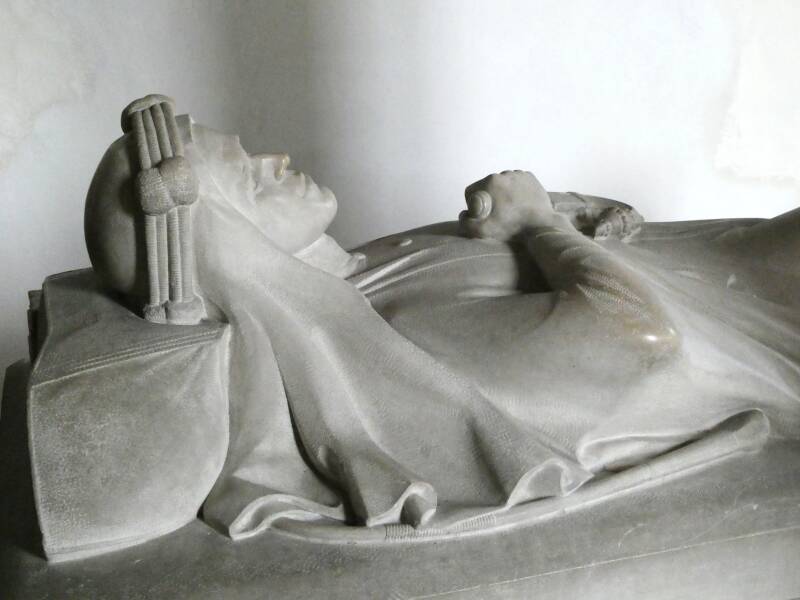
This effigy was sculpted between 1936 and 193 by Eric Cannington, an official war artist and a close friend of T E Lawrence, ‘Lawrence of Arabia’. Cannington took the style of a medieval knight’s tomb and adapted it to reflect Lawrence’s complex life.
It was intended for St Paul’s Cathedral, but because of political controversy surrounding Lawrence’s difficult dealings with the British government and his unconventional lifestyle, the offer was refused. It was then offered to Westminster Abbey, but was rejected for the same reasons. The Dean of Salisbury Cathedral also declined the offer, arguing that the effigy of Lawrence lying in Arab robes was ‘distasteful’ and inappropriate for an English cathedral.
After the First World War Lawrence lived in Clouds Hill, between Dorchester and Wareham. He died in a motor bike accident, and although he is buried at St Nicholas’ Church in Moreton, even the vicar there refused the effigy, claiming it would ‘spoil the look’ of his church.
Lawrence was an archaeologist with a passion for medieval history. He frequently visited St Martin’s-on-the-Wall in Wareham and had taken a great interest in the conservation of the ancient church, so the vicar offered to house the effigy. Although it fills most of the north aisle, it looks perfectly at home in the ancient church, lying peacefully with the ghosts of knights of old. I’m sure Lawrence is happy to be remembered there, in the village where he found some peace at the end of his troubled life.
The Legend of Betsy Grimbal
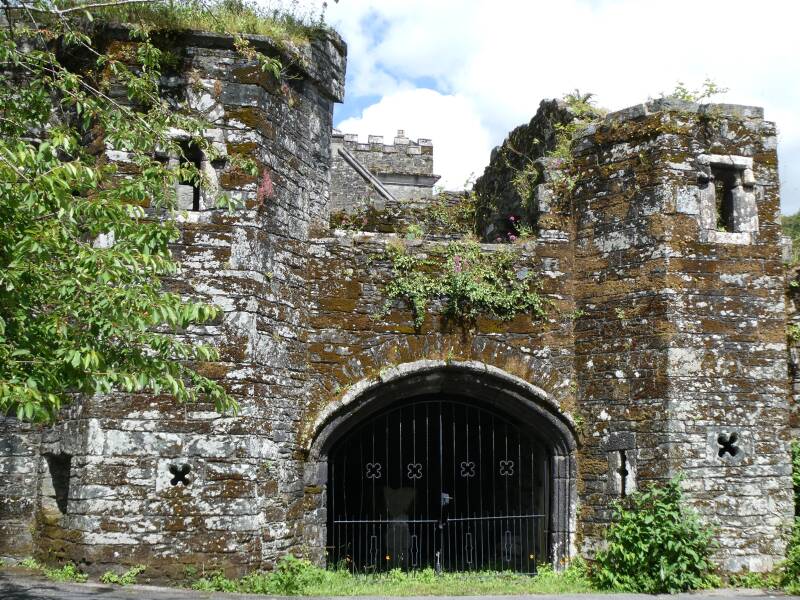
Betsy Grimbal's Tower is a medieval gatehouse and one of the primary surviving remnants of Tavistock Abbey in Devon. Built mostly during the 15th century, it served as the grand western entrance gateway to the original Benedictine abbey precincts, featuring twin flanking towers and moulded arches. Local folklore attributes the name to an unfortunate young woman allegedly murdered by a jealous monk at the site, though experts suggest it is more likely to be a corruption of the name ‘Blessed Grimbald’.

This pious and learned Benedictine was invited to England by King Harold in 885 and appointed Abbot of New Minster Abbey in Winchester. Although he had no direct links to Tavistock, he was widely venerated for his contributions to the church and the monastic community. He is often pictured wearing a crown, possibly one of the five Heavenly Crowns promised to believers in the afterlife, but looks more like King Arthur himself than a humble monk. This confusion appears to have arisen mainly because of a blurred image of Grimbald and Alfred once pictured together.

The fate of the unfortunate Betsy is known only through folklore. A vicar of Tavistock, Rev. Bray, spent his childhood in the house next to the ruins in the late 1700’s. He reported his great distress upon learning that a young woman had been murdered in the gateway, and of his terror at seeing red stains on the walls, rumoured to be her dried blood. These were actually caused by mineral deposits and iron oxide leaching out of the Devon stone, but to his young mind, they were proof that the gateway was haunted. There are no parish records about Betsy, or any concrete evidence that she even existed, but her name lives on the dramatic story of a ghost and a murder that naturally evolved to fit such a bleak setting.
Voynich Manuscript
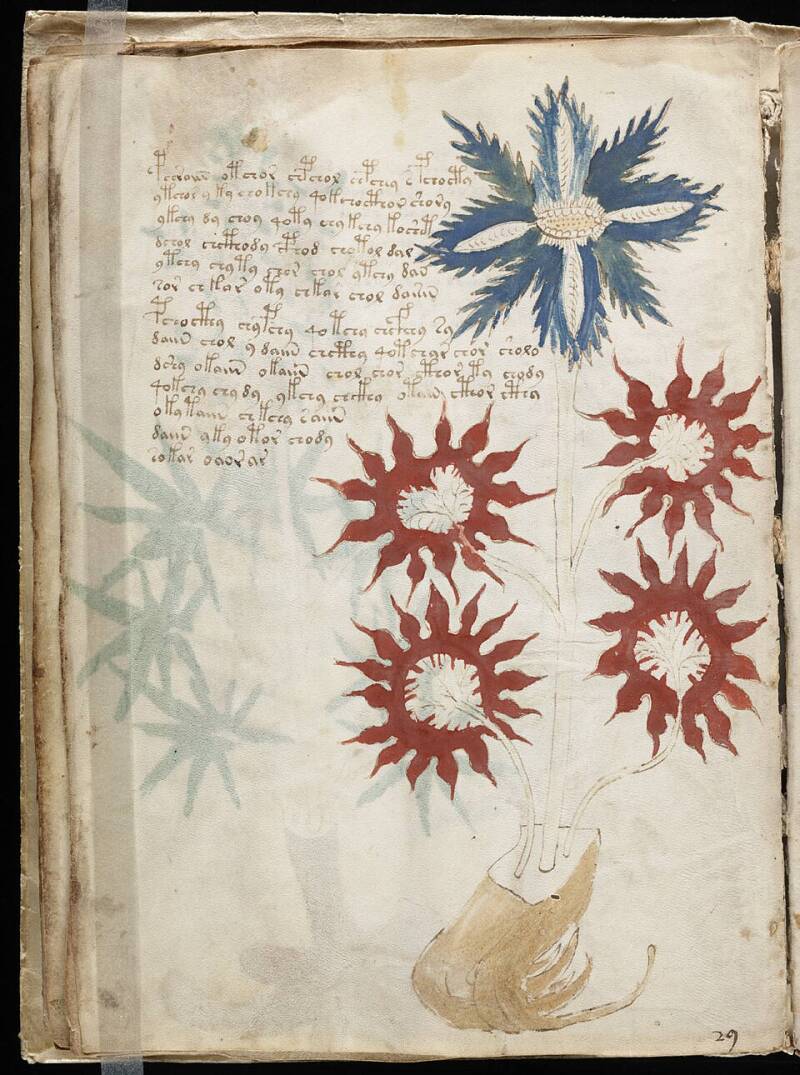
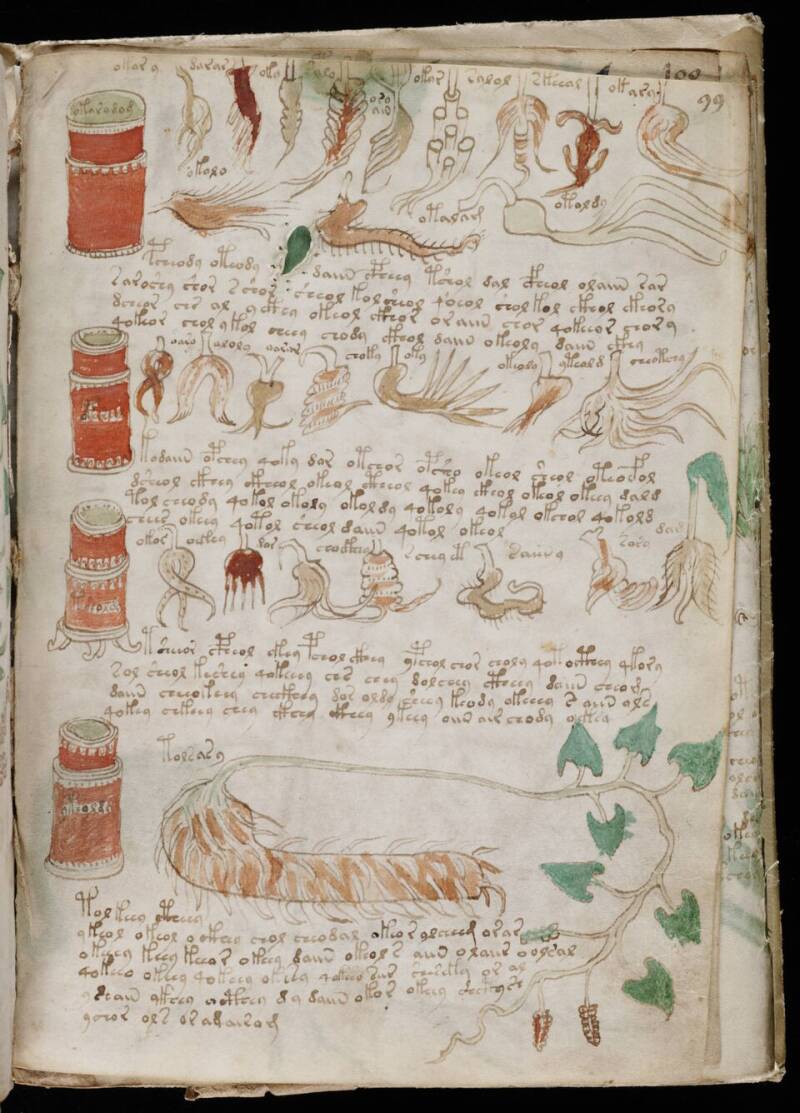

A new article concerning the Voynich Manuscript has been published by Colin Layfield and Lisa Fagin Davis, arguing that the pages should be arranged like a stack of cards, not bound together as they were during the mid to late 15th century. They suggest that the pages were a set of booklets, passing information down through the generations, not written by just one person (who at one time was rumoured to have been Leonardo da Vinci).
There are 240 pages written in a as yet undeciphered script, dated by radiocarbon to within 1404 and 1438. Its meaning has been the cause of scholastic debate since it first appeared in 1912 in a rare book market in Italy. The pages are divided into six sections and contain drawings of astronomy, botany, pharmaceuticals, anatomy, (including some saucy drawings of females bathing!) and what are assumed to be recipes. To me, it has an earthy appeal, grounded in everyday life, and I favour the explanation that is some kind of instruction manual, but the truth remains hidden until the cipher can be decoded.
The photos are attributed to’ Unknown author’ - Beinecke Rare Book & Manuscript Library, Yale University ([1])., Public Domain, https://commons.wikimedia.org/w/index.php?curid=7982009
Create Your Own Website With Webador